logo

dr-james-hawkins

  • icon-cloud
  • icon-facebook
  • icon-feed
  • icon-feed
  • icon-feed

Psychotherapy with couples & other close relationships

Over the next two days I'm due to run a two day training workshop in Glasgow on "Psychotherapy with couples & other close relationships".  Here are the downloadable slides for the first day on "Working with couples(sadly with the cartoons removed for copyright reasons) and here the slides for the second day on "Close relationships".  There are lots of relevant handouts - here are the details.
How to live well: 7th meeting - relationships, roles, Dunbar, needs & dyads


           "Of all the means which wisdom acquires to ensure happiness throughout the whole of life,                                                                    by far the most important is friendship."           Epicurus

        "Friendship is the single most important factor influencing our health, well-being, and happiness."                                                            Robin Dunbar, Oxford emeritus professor of evolutionary psychology 

Social networks: Dunbar's 5-15-50-150 model (assessing how we're doing)

“ Those who dream by night in the dusty recesses of their minds wake in the day to find it was vanity, but the dreamers of the day are dangerous men for they may act their dream with open eyes to make it possible. ” - T. E. Lawrence

                       Social networks: Dunbar's 5-15-50-150 model (assessing how we're doing)

key points: 


1.)  Please would you download a personal community map (see below) and begin to fill it in. 


2.)  While filling in the map and afterwards, answer the items on the associated questionnaire ... and start to jot down possible intentions too.


Social networks: Dunbar's 5-15-50-150 model (sympathy group & full active network)

“ Doctors came to see her singly and in consultation, talked much in French, German, and Latin, blamed one another, and prescribed a great variety of medicines for all the diseases known to them, but the simple idea never occurred to any of them that they could not know the disease Natasha was suffering from, as no disease suffered by a live man can be known, for every living person has his own peculiarities and always has his own peculiar, personal, novel, complicated disease, unknown to medicine. ” - Leo Tolstoy

               Social networks: Dunbar's 5-15-50-150 model (sympathy group & full active network)


key point: 


Social networks: Dunbar's 5-15-50-150 model (support clique/closest relationships)

“ There is nothing so practical as a good theory. ” - Kurt Lewin

                         Social networks: Dunbar's 5-15-50-150 model (support clique/closest relationships)

key point: 


In this first part of three on Dunbar's 5-15-50-150 personal social network model, I introduce the crucially important inner layer - the 'support clique' of closest relationships.


Ch.7: Families

Everything can be taken from a man but one thing: the last of the human freedoms - to choose one’s attitude in any given set of circumstances, to choose one’s own way.

- Viktor Frankl

Personal social networks (5th post): the frequency of conflict

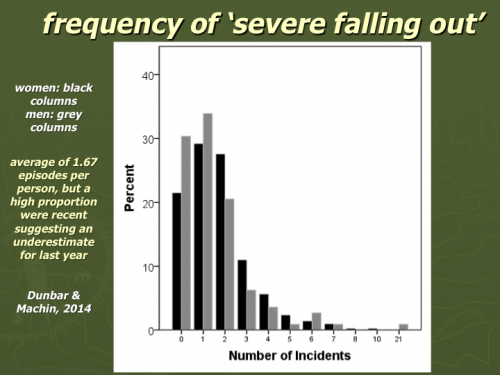
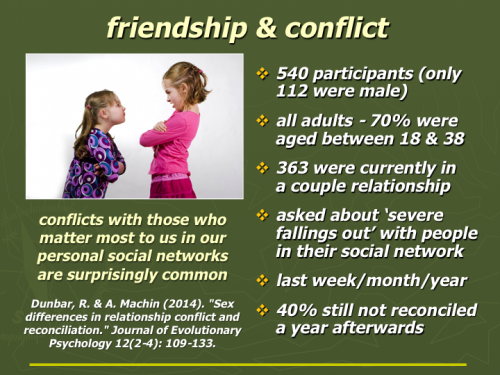
Personal social networks are hugely important for our health & wellbeing, as I've underlined in the first of this six post sequence - "Personal social networks (1st post): Dunbar's 5-15-50-150 model".  However our personal networks are also regularly affected by conflicts, especially with those we're close to.  It's not a surprise - if you're very close to someone, it's likely you'll sometimes step on each other's toes.  Here are a set of four slides that illustrate this point:

Personal social networks (4th post): birds of a feather flock together

I've recently written three blog posts about relationships - "Personal social networks (1st post): Dunbar's 5-15-50-150 model", "Personal social networks (2nd post): the sympathy group & the full active network" and "Personal social networks (3rd post): assessing how we're doing" Towards the end of the second of these posts I said I particularly like the paper "Do birds of a feather flock together?"&nbsp

Personal social networks (3rd post): assessing how we're doing

If you'd like to clarify and potentially look after your personal social network better, a good place to start is to chart it. You can download a simple blank chart here either in Word doc or PDF format.  Filling in the whole "Personal community map" can take a good hour or two, so possibly ... at this stage ... just put your support clique into the most central circle.

Syndicate content