In good time we shall see God and his light, you say - Fool, you shall never see what you not see today!
- Angelus Silesius

Life skills for stress, health & wellbeing

In the 1970's I taught yoga and several different types of meditation.  In the 1980's I began teaching courses in Autogenic Training, a form of deep relaxation/meditation.  I continued running Autogenic classes for about 25 years.  In addition to the relaxation/meditation exercises, the teaching also covered several other life skill/stress management techniques.  For a much fuller description of these eight session courses, visit the Autogenic Training section of this website.

Further Pages

Recent research: articles from March journals

I read a lot of research.  When I find an article of particular interest I download it to my bibliographic database - EndNote - which currently contains over 14,100 abstracts. 

Developing a training course: life skills for stress, health & wellbeing

Last Spring, I went walking and camping in Glen Affric.  Amongst other things, being away on my own in the hills gave me a chance to think creatively.  Once I was back I wrote a blog post about developing a next generation stress management course.  I said "I've known for some time that I wanted to "upgrade" the stress management/relaxation skills course that I've been teaching for many years.  I find the emerging research on mindfulness-based cognitive therapy (MBCT) exciting and encouraging ...

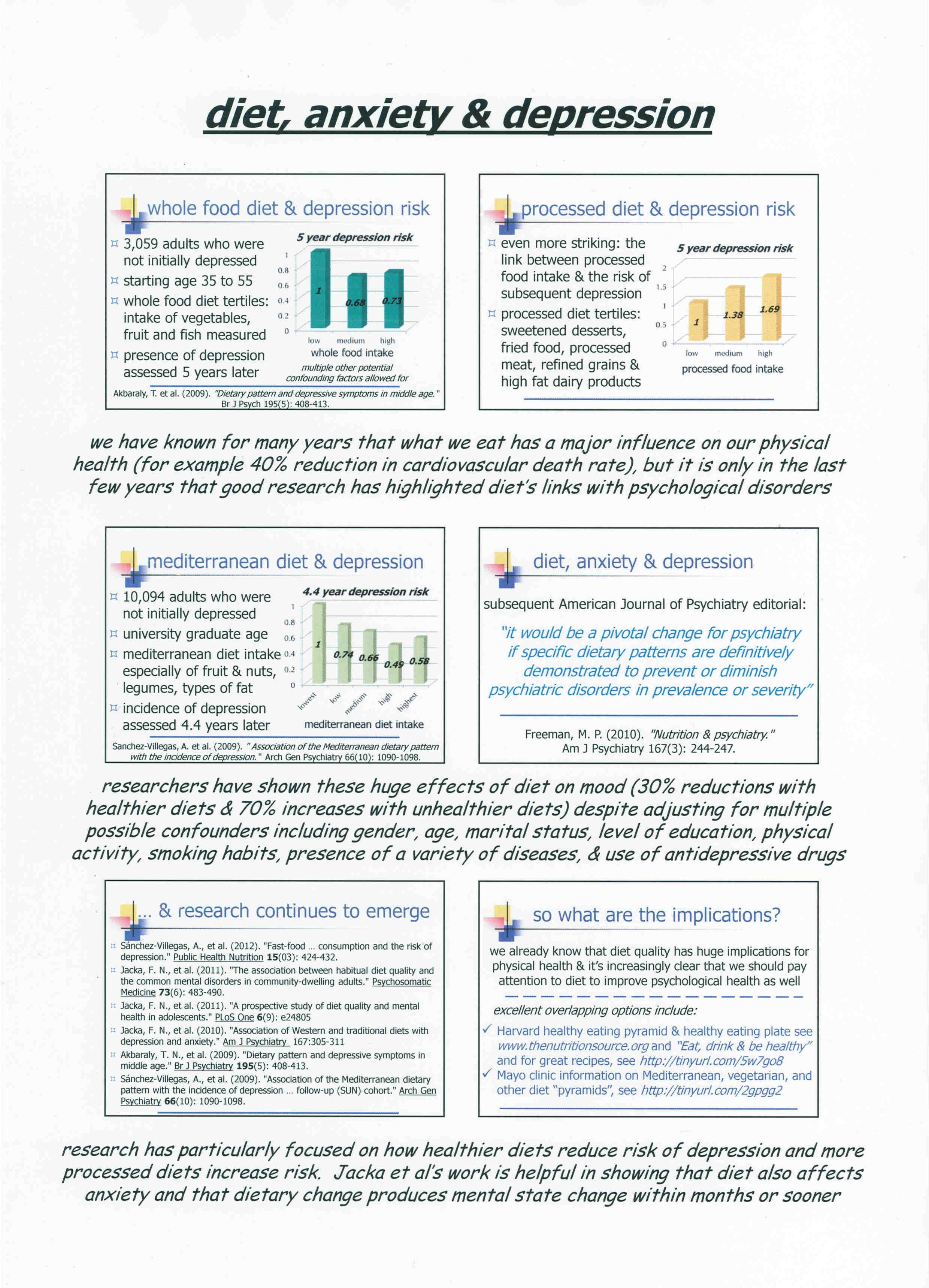
New research shows diet’s importance for preventing depression

You know how it is - no buses in sight, then two come along at once.  It's been a bit similar for good research on diet and depression.  There have been plenty of studies on individual components of diet and mood (e.g. fish, folate, other B vitamins), but very little on the possible psychological effects of diet as a whole.  Then in October's edition of Archives of General Psychiatry, along came:

Recent research: diet associated depression, weight & violence, vitamin D fall prevention, IBS & anxiety, yoga & mindfulness

Here are a mixed bag of six recent research papers on diet, vitamin D, IBS and yoga (all details & abstracts to these studies are listed further down this blog post).  The first three papers highlight the toxic effects on psychological health, physical health, and society of our processed, high sugar diets.  Sanchez-Villegas et al map a bit more clearly the potential link between diet and depression.  They conclude "Our results suggest a potential protective role of the MDP (Mediterranean dietary pattern) with regard to the prevention of depressive disorders; additional longitudinal studies and trials are needed to confirm these findings."  Fiorito et al show that intake of sweetened drinks in 5 year old girls predicts overweight over subsequent childhood and adolescence, and - rather scarily - Moore & colleagues show a link between confectionary consumption at age 10 and subsequent violence in adulthood.  They concluded "Children who ate confectio

Recent research: articles from September journals

I read a lot of research.  When I find an article of particular interest I download it to my bibliographic database - EndNote - which currently contains nearly 13,500 abstracts. 

Recent research: articles from August journals

I read a lot of research.  When I find an article of particular interest I download it to my bibliographic database - EndNote - which currently contains over 13,000 abstracts. 

Recent research: 3 studies on diet & (cardiovascular) health, 2 on fish oil, dementia & postpartum depression, and 1 on walnuts!

Here are half a dozen studies on diet (see below for all abstracts and links).  The first three are about the benefits of healthy lifestyle.  Trichopoulou & colleagues evaluated the contribution of nine widely accepted components of the Mediterranean diet (high intake of vegetables, fruits and nuts, legumes, fish, and cereals; low intake of meat and dairy; high ratio of monounsaturated to saturated lipids; and moderate intake of ethanol) in the inverse association of this diet with all cause mortality.  They concluded that "The dominant components of the Mediterranean diet score as a predictor of lower mortality are moderate consumption of ethanol, low consumption of meat and meat products, and high consumption of vegetables, fruits and nuts, olive oil, and legumes.

Syndicate content