Recent research: mindfulness (mechanisms & practice), prevalence (abuse & suicidality), health anxiety imagery & CBT for kids

Here are half a dozen recent research studies - two on aspects of mindfulness, two on sobering prevalence rates, one on imagery in health anxiety, and one on CBT with children.  Fuller details, links and abstracts for all studies are listed further down this page.  Willem Kuyken and colleagues looked at "How does mindfulness-based cognitive therapy (MBCT) work?" in helping recurrent depression sufferers.  They came up with some fascinating and provocative findings.  For example it appears that MBCT acts differently from standard CBT, although they are both helpful in reducing risk of depressive relapse.  Standard CBT (and maintenance antidepressants too) reduce cognitive reactivity to experiences of induced low mood, and this appears important in how they lessen relapse risk.  MBCT however seems to act not by reducing cognitive reactivity so much as by decoupling the reactivity from a tendency then to slide into depression.  It appears this decoupling is mediate

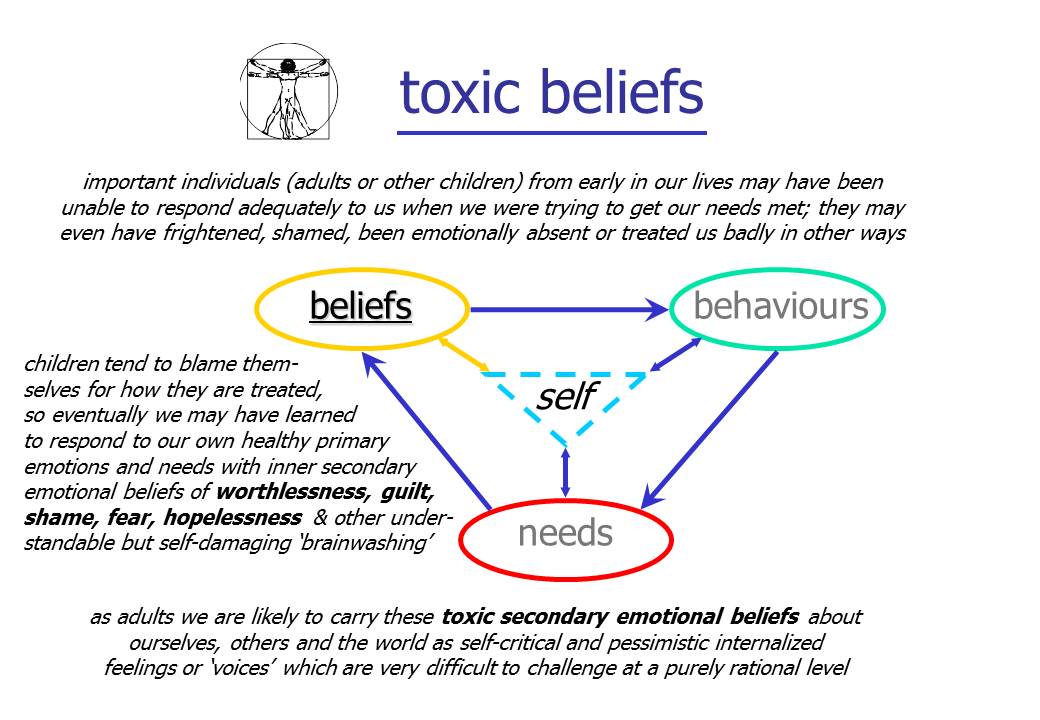
Our life stories: needs, beliefs & behaviours - part two, "beliefs"

I posted yesterday on the first, "Needs" section of the "Needs, beliefs, behaviours" diagram (below).  Today I want to say a little about the second section of the diagram - "Beliefs".

Beliefs

This diagram is downloadable both as a Powerpoint slide and as a PDF file

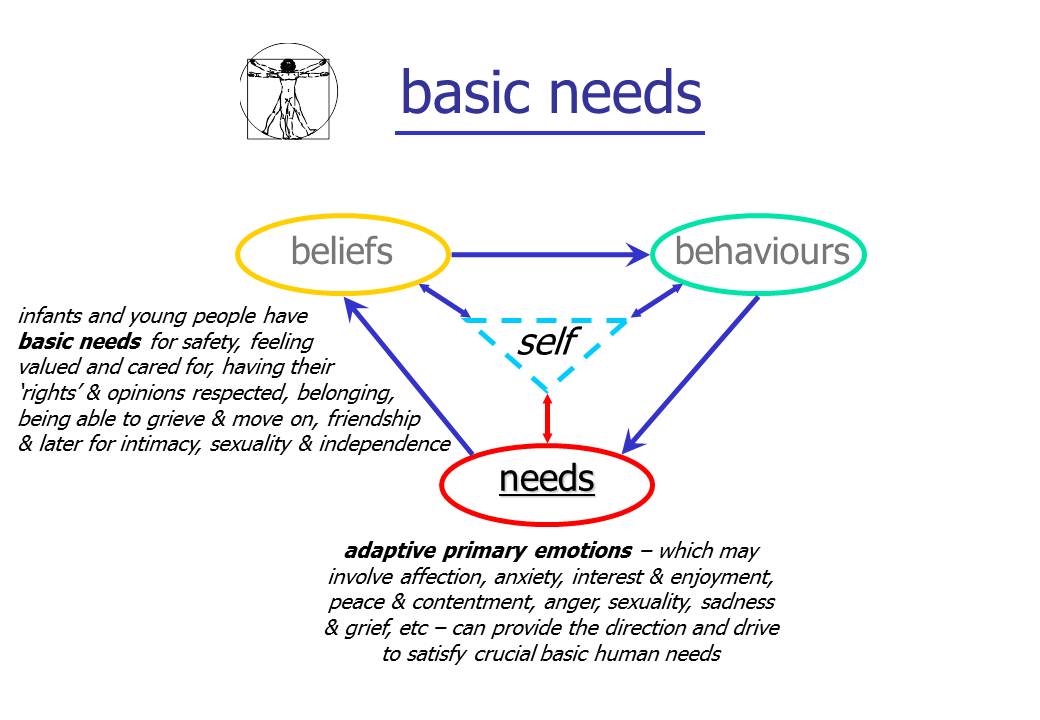
Our life stories: needs, beliefs & behaviours - part one, "needs"

This is the first of a series of four brief posts giving more information about a model I use a lot, especially when working with people who are trying to change long term personality patterns.  The ideas aren't at all original, although this particular way of presenting them is my own.  So the first step in the model is "needs".  This is illustrated in the following diagram:

Needs

This diagram is downloadable both as a Powerpoint slide and as a PDF file

Gratitude and dedication

On the 15th March 2010 my dear, precious mother Edie Hawkins died.  She was 97 and I'm writing this post ten days later.  After the funeral, after the flurry of forms and arrangements and visits and paperwork have quietened down.

I woke early this morning.  Thought about her.  A sense of her.  She was an immensely kind, giving, determined, selfless person.  This website wouldn't be here without the influence of her and my father, Jim Hawkins (who died back in 1989) - also such a generous, caring, thoughtful human being. 

If you've found anything of value on this site - if it's helped you personally or in your work, please say an inner thank you to Edie and Jim.  This website wouldn't be here if it wasn't for them and how they've influenced what I believe in and what I work for.


 

Recent research: articles from February journals

I read a lot of research.  When I find an article of particular interest I download it to my bibliographic database - EndNote - which currently contains over 14,000 abstracts. 

Our life stories: needs, beliefs & behaviours

This post describes the "Needs, beliefs & behaviours" diagrams, best viewable on screen in PDF format (slides 1 & 2 and slides 3 & 4), but also downloadable in Powerpoint format (slides 1 & 2 and slides 3 & 4).  The post below is downloadable as a Word format handout. 

Assessing attachment in adults

I'm a doctor and psychotherapist who's interested in using attachment ideas to improve how helpful I can be for clients.  Awareness of attachment issues informs therapy, it doesn't dictate it.  An obvious question is whether it's sometimes worth assessing attachment in a "formal" way.  I'm no expert in this area.  I'm an "informed amateur" and, after reading and exploring a good deal around the subject, my impression is that it can be pretty useful at times to assess attachment.  The Wikipedia article on Attachment measures provides an excellent overview of the field while, for much more in depth information, the two attachment books and the various websites that I've described in previous blog post

Recent research: six papers with broad social implications – inequality, health insurance, spanking, bullying, and religion

Here are half a dozen recent research papers with broad social implications (all details & abstracts to these studies are given further down this blog posting).  Kay and colleagues publish on "Inequality, discrimination, and the power of the status quo: Direct evidence for a motivation to see the way things are as the way they should be."  They report four studies showing how widely this motivation acts - with political power, public funding, gender demographics, and in attacks on those who are trying to work for change.  There's relevance here to the second paper by Wilper et al on "Health Insurance and Mortality in US Adults" estimating that, even after adjusting for income, education, health status, weight, exercise, smoking and alcohol use, lack of insurance was associated with about 45,000 excess deaths annually in the United States among people aged 18 to 64.  Still in the area of inequality and discrimination, Wexler et al publish on

Syndicate content